Securing funding for a startup is a crucial step, and understanding the nuances between venture capital and angel investors is paramount. Both offer financial backing, but their approaches, investment sizes, and levels of involvement differ significantly. This exploration delves into these key distinctions, helping entrepreneurs navigate the complexities of securing capital for their ventures.
From the initial seed funding stages to later-stage Series A and beyond, the paths to securing capital diverge based on the investor type. Angel investors often provide smaller, early-stage investments, while venture capitalists typically invest larger sums at later stages, demanding more equity in return for their higher risk tolerance. This analysis will clarify these differences and guide entrepreneurs towards the most suitable funding source for their specific needs.
Venture Capital Overview
Venture capital (VC) firms provide funding to startups and small businesses with high growth potential. Unlike angel investors who often invest smaller sums at earlier stages, VCs typically invest larger amounts in later stages of a company’s development, expecting significant returns on their investment. This funding comes with a degree of control and influence over the company’s strategic direction.Venture capital investment is a high-risk, high-reward endeavor.
The vast majority of VC-backed companies fail, but the successes can generate enormous returns for the investors. Understanding the various stages of VC investment and the characteristics of typical deals is crucial for both entrepreneurs seeking funding and investors considering this asset class.
Venture Capital Investment Stages
Venture capital firms typically invest across several stages of a company’s lifecycle. These stages represent different levels of maturity, risk, and required funding. Each stage attracts different types of investors and comes with varying expectations for returns and company milestones.
Characteristics of a Typical Venture Capital Deal
A typical venture capital deal involves a significant financial investment in exchange for equity in the company. This means the VC firm receives a percentage ownership stake in the business. Beyond the capital, VC firms often provide valuable mentorship, industry connections, and strategic guidance to help the company grow. Negotiations involve detailed due diligence, valuation discussions, and legal agreements that protect both the investors and the entrepreneurs.
Terms typically include clauses related to liquidation preferences, board representation, and future funding rounds. The entire process can be lengthy and complex, requiring significant expertise from both sides.
Industries Attracting Venture Capital Investment
Venture capital investments are concentrated in sectors with high growth potential and the possibility of disruptive innovation. While this can shift based on market trends and technological advancements, some consistently popular areas include:* Technology: Software as a Service (SaaS), Artificial Intelligence (AI), Fintech, Biotechnology, and E-commerce are consistently popular sectors. These industries offer opportunities for rapid scaling and significant market disruption.
Healthcare
Biotechnology, medical devices, and digital health are attractive due to the significant unmet needs and potential for high returns. The regulatory landscape presents challenges, but the potential rewards are substantial.
Consumer Goods
Companies focused on innovative consumer products, particularly those leveraging technology, often attract significant VC interest. The large market size and potential for widespread adoption drive investment.
Types of Venture Capital Funds
The following table summarizes the key differences between various types of venture capital funds:
| Fund Type | Investment Stage | Typical Investment Size | Focus |
|---|---|---|---|
| Seed Funding | Pre-revenue or early revenue | $100,000 – $2 million | Idea validation, product development, initial team building |
| Series A | Post-seed, significant traction | $2 million – $15 million | Scaling operations, market expansion, team growth |
| Series B | Established product-market fit, substantial revenue | $10 million – $50 million | Aggressive growth, market dominance, strategic acquisitions |
| Growth Equity | Mature companies with proven track records | $50 million+ | Expansion into new markets, strategic investments, potential IPO preparation |
Angel Investor Overview
Angel investors are high-net-worth individuals who provide capital for startups in exchange for equity. They often play a crucial role in the early stages of a company’s development, offering not only funding but also valuable mentorship and industry connections. Unlike venture capitalists, who typically invest larger sums at later stages, angel investors are often the first significant source of external funding for many businesses.Angel investors are a diverse group, but some common characteristics emerge.
Many are successful entrepreneurs themselves, possessing firsthand experience in building and scaling businesses. This experience provides them with a unique perspective and understanding of the challenges faced by startups. Their investment strategies vary, but a common thread is a focus on high-growth potential, even if it involves a higher degree of risk. They often seek opportunities to actively participate in a company’s growth, providing guidance and leveraging their networks to assist with business development.
Angel Investor Investment Amounts and Stages
Angel investors typically invest smaller amounts of capital compared to venture capitalists. Investment sizes range widely, from a few thousand dollars to several hundred thousand dollars, depending on the investor’s personal wealth and the stage of the startup. They frequently participate in seed funding rounds or Series A rounds, providing crucial capital for initial product development, market entry, and team expansion.
These early-stage investments are often critical for a startup’s survival and growth, as they allow the company to build a foundation before seeking larger investments. For example, an angel investor might invest $50,000 in a promising tech startup to help them develop a minimum viable product (MVP) and test the market.
Angel Investors versus Venture Capitalists: Investment Size and Risk Tolerance
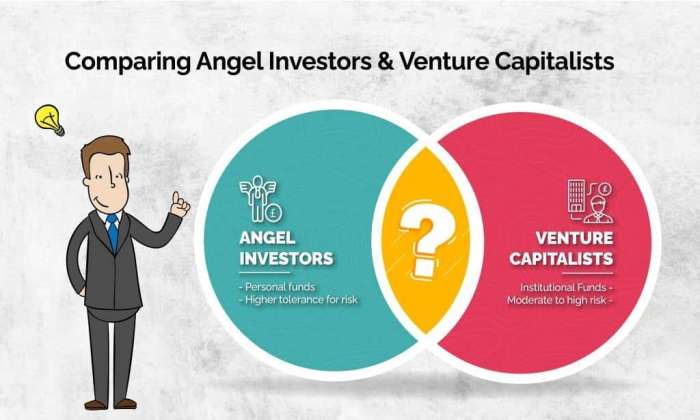
A key difference between angel investors and venture capitalists lies in their investment size and risk tolerance. Venture capitalists typically invest significantly larger sums, often millions of dollars, in later-stage companies with proven track records. Angel investors, on the other hand, are more comfortable with higher risk and invest smaller amounts in earlier-stage ventures with greater uncertainty. Their smaller investments allow them to diversify their portfolio and mitigate potential losses from failed ventures.
This higher risk tolerance is often compensated by the potential for significantly higher returns if the startup is successful. For instance, an angel investor might accept a higher chance of failure in exchange for a larger equity stake in a promising, albeit risky, company. In contrast, a venture capitalist might require a more established business model and market traction before making a substantial investment.
Due Diligence Processes: Angel Investors versus Venture Capitalists
The due diligence processes of angel investors and venture capitalists differ significantly in scope and depth.
- Angel Investors: Angel investors often conduct less formal due diligence, relying more on their intuition, network, and personal experience. Their process may involve reviewing the business plan, meeting the founding team, and conducting some market research. The focus is on assessing the team’s capabilities and the overall potential of the business idea.
- Venture Capitalists: Venture capitalists typically employ a more rigorous and comprehensive due diligence process. This involves a thorough financial analysis, market research, competitive analysis, and legal review. They often engage specialized consultants and experts to assess the various aspects of the business, including technology, intellectual property, and market opportunities. The depth of due diligence reflects the larger investment amounts and the higher stakes involved.
Comparing VC and Angel Investors

Venture capitalists (VCs) and angel investors both provide crucial funding for startups, but their approaches differ significantly. Understanding these differences is vital for entrepreneurs seeking funding. This section will compare and contrast their investment processes, focusing on decision-making, investment terms, support levels, and exit strategies.
Investment Decision-Making Processes
Venture capitalists typically employ a rigorous, multi-stage process. This involves extensive due diligence, often including market research, competitive analysis, and detailed financial projections review. Teams of professionals evaluate investment opportunities, prioritizing companies with high growth potential and scalable business models. The decision-making process often involves multiple partners and can take several months. In contrast, angel investors, often individuals with prior entrepreneurial experience, tend to rely on a more streamlined process.
While due diligence is still important, the decision-making is often faster and more intuitive, frequently based on a combination of business acumen, personal connections, and gut feeling. Decisions may be made within weeks, sometimes even days.
Investment Agreement Terms and Conditions
VC investment agreements are usually complex legal documents, reflecting the substantial investment amounts and the inherent risks. They typically include provisions for preferred stock, liquidation preferences, board representation, and other protective measures for the VC firm. These terms often give VCs significant control over the company’s strategic direction. Angel investors, conversely, frequently use simpler agreements, potentially employing convertible notes or SAFE (Simple Agreement for Future Equity) agreements, particularly in early-stage investments.
These agreements often provide less control to the investor and typically involve less complex legal language. While terms still protect the angel’s investment, they’re generally less demanding than those imposed by VCs.
Level of Involvement and Ongoing Support
VCs typically provide not only capital but also significant ongoing support. This includes mentoring, strategic guidance, access to their network, and assistance with recruiting and operations. They actively participate in the company’s management, often holding board seats. Angel investors may also offer mentoring and guidance, leveraging their experience and contacts, but their level of involvement is generally less intensive than that of VCs.
Their support is often more advisory in nature, depending on their expertise and the specific needs of the startup.
Exit Strategies
VCs generally aim for a high-growth exit strategy, typically involving an initial public offering (IPO) or acquisition by a larger company. Their investment timeline usually spans several years, with the goal of maximizing returns through significant capital appreciation. Angel investors may also seek an IPO or acquisition, but their exit strategies are often more diverse. They might be content with a smaller return achieved through an acquisition or a secondary sale of their equity.
Some angel investors are willing to hold their investment for a longer period, especially if they believe in the company’s long-term prospects. For example, an angel investor might be satisfied with a successful sale to a strategic buyer, even if it doesn’t represent a massive financial windfall, while a VC firm might need a much larger return to satisfy its limited partners.
Comparing VC and Angel Investors
Venture capitalists and angel investors both provide crucial funding for startups, but their approaches, resources, and expectations differ significantly. Understanding these differences is vital for entrepreneurs seeking funding. This section will delve into the typical profiles of each investor type, highlighting how their backgrounds shape their investment strategies.
Venture Capitalist Firm Profiles
Venture capital firms are typically established organizations with a dedicated team of professionals. Their investment focus is often highly specialized, targeting specific industries or stages of company development (e.g., seed stage, Series A, etc.). The team usually includes partners with extensive experience in finance, investment analysis, and often, relevant industry expertise. They possess a robust network within the business community and access to significant capital pools.
Their investment decisions are data-driven, relying on rigorous due diligence, market analysis, and projections of future growth and profitability. For example, a firm specializing in biotech might have partners with PhDs in relevant scientific fields, allowing them to assess the technical feasibility and market potential of innovative therapeutics.
Angel Investor Profiles
Angel investors are typically high-net-worth individuals who invest their personal capital in early-stage companies. Their backgrounds are diverse, ranging from successful entrepreneurs and executives to experienced professionals in various fields. Angel investors often invest based on a combination of factors including market opportunity, team strength, and personal connections. Their networks can be invaluable to startups, providing access to mentorship, industry contacts, and potential future funding rounds.
A successful entrepreneur turned angel investor, for instance, might prioritize investments in companies with innovative business models similar to their own past successes, leveraging their operational expertise to guide the startups.
Investor Background Influence on Investment Decisions
The background and experience of both VCs and angel investors profoundly influence their investment choices. A VC firm with a strong track record in software development is more likely to invest in a promising SaaS startup than a firm focused on renewable energy. Similarly, an angel investor with a deep understanding of the healthcare industry might be more inclined to fund a medical device company, while another with a background in consumer goods might prefer a direct-to-consumer brand.
This specialization often leads to more informed investment decisions and stronger support for portfolio companies.
Key Differences in Investor Profiles
| Characteristic | Venture Capital Firm | Angel Investor | Example |
|---|---|---|---|
| Investor Type | Established firm with multiple partners | Individual investor | Sequoia Capital vs. a retired tech executive |
| Investment Size | Larger investments (hundreds of thousands to millions) | Smaller investments (tens of thousands to hundreds of thousands) | $5M Series A round vs. $50k seed funding |
| Investment Stage | Typically later stages (Series A and beyond) | Often earlier stages (seed, pre-seed) | Series B funding vs. initial product development funding |
| Investment Focus | Specific industry or stage focus | Diverse, often based on personal interest and expertise | Focus on Fintech vs. investments across various sectors |
Venture Capital and the Travel Industry
Venture capital (VC) has played a significant role in shaping the modern travel industry, fueling innovation and accelerating the growth of companies that are transforming how we plan, book, and experience travel. The infusion of capital has not only supported the development of new technologies but also fostered competition and ultimately benefited consumers with more choices and improved services.The travel industry, traditionally characterized by established players and established business models, has undergone a dramatic shift in recent years.
This transformation is largely due to the influx of venture capital into innovative travel technology startups. VC firms recognize the immense potential of this sector, driven by factors such as the increasing adoption of smartphones, the rise of the sharing economy, and the growing demand for personalized travel experiences. This investment has facilitated the development of disruptive technologies and business models, leading to significant changes in how people plan and book their trips.
Venture Capital’s Influence on Travel Technology
Venture capital funding has been instrumental in developing and deploying various travel technologies. This includes the creation of sophisticated booking platforms, personalized travel recommendation engines, and innovative solutions for managing travel logistics. The capital allows startups to scale their operations, expand their market reach, and compete with established players. This competition, in turn, drives innovation and improves the overall travel experience for consumers.
For example, the development of dynamic pricing algorithms, which optimize pricing based on real-time demand, is largely a result of VC-backed innovation. This allows for more efficient resource allocation and greater affordability for consumers.
Examples of Successful VC-Backed Travel Companies
Several prominent travel companies owe their success, at least in part, to venture capital funding. Airbnb, a global leader in the short-term rental market, secured significant VC investment during its early stages, allowing it to expand rapidly and disrupt the traditional hospitality industry. Similarly, Booking.com, a major online travel agency, benefited from early-stage venture capital, which enabled it to build a comprehensive platform and establish a dominant market position.
These examples illustrate the transformative power of VC investment in the travel sector. Other successful examples include companies like Kayak (metasearch engine) and Skyscanner (flight comparison website), which leveraged VC funding to build powerful data-driven platforms.
Risks and Rewards of Investing in Travel Startups
Investing in travel startups presents both significant opportunities and substantial risks. A thorough understanding of these factors is crucial for investors.
The potential rewards include:
- High growth potential: The travel industry is vast and constantly evolving, offering substantial opportunities for rapid growth and high returns.
- Disruptive innovation: Investing in innovative startups can lead to participation in paradigm shifts within the travel industry.
- First-mover advantage: Early-stage investment can secure a position in a rapidly expanding market.
However, several risks need careful consideration:
- High competition: The travel industry is highly competitive, with both established players and numerous emerging startups vying for market share.
- Economic sensitivity: The travel industry is particularly susceptible to economic downturns, which can significantly impact demand and profitability.
- Regulatory hurdles: The travel industry is subject to various regulations and compliance requirements, which can pose challenges for startups.
- Technological disruption: Rapid technological advancements can quickly render existing technologies and business models obsolete.
- Seasonality: Demand for travel services fluctuates significantly throughout the year, impacting revenue streams.
Travel Hacks and Tips
Planning a trip can be exciting, but managing costs and ensuring a smooth journey requires careful consideration. This section offers practical travel hacks and tips to help you navigate the complexities of travel, maximizing your enjoyment while minimizing stress and expenses.
Money-Saving Flight and Accommodation Hacks
Finding affordable flights and accommodation is crucial for budget-conscious travelers. Several strategies can significantly reduce travel costs.
- Be flexible with your travel dates: Mid-week flights and travel during the off-season often offer significantly lower prices. Consider flying on Tuesdays or Wednesdays, and avoid peak travel periods like holidays and school breaks.
- Use flight comparison websites: Websites like Google Flights, Skyscanner, and Kayak allow you to compare prices from various airlines and travel agencies simultaneously. Experiment with different departure and arrival airports to find better deals.
- Consider alternative airports: Flying into a smaller, less popular airport near your destination might offer cheaper flights. Weigh the cost savings against the added travel time to your final destination.
- Book accommodation in advance, but stay flexible: Booking ahead secures better rates, especially during peak seasons. However, utilize tools that allow for flexible date changes to take advantage of price drops.
- Explore alternative accommodation options: Consider staying in hostels, guesthouses, or Airbnb rentals instead of traditional hotels for potentially significant cost savings. Hostels, in particular, are a great way to meet fellow travelers.
Tips for a Smooth and Stress-Free Journey
A well-planned trip minimizes stress and maximizes enjoyment. These tips contribute to a smoother travel experience.
- Pack light: Overpacking adds weight and can lead to extra baggage fees. Choose versatile clothing items that can be mixed and matched, and only pack essential toiletries.
- Organize your documents digitally and physically: Keep copies of your passport, visa, tickets, and other important documents both digitally (cloud storage or email) and physically in a secure, separate location. This safeguards against loss or theft.
- Inform your bank and phone provider of your travel plans: This prevents your cards from being blocked due to unusual activity and ensures you can access your phone and data abroad. Consider purchasing a local SIM card for better connectivity and lower roaming charges.
Methods for Finding Affordable Travel Insurance
Travel insurance protects against unforeseen circumstances, but finding affordable coverage is essential.
- Compare quotes from multiple insurers: Use comparison websites to compare prices and coverage from different providers. Pay close attention to the policy details and ensure it meets your specific needs.
- Consider your travel needs: Choose a policy that offers the appropriate level of coverage for your trip’s duration and activities. A longer trip or one involving adventurous activities will require more comprehensive insurance.
- Look for discounts and promotions: Some insurers offer discounts for students, seniors, or those booking travel insurance alongside their flights or accommodation. Check for special offers before purchasing.
Travel Visa Requirements
Travel visa requirements vary significantly depending on your nationality and destination. It’s crucial to research the specific requirements well in advance of your trip. The following table provides a simplified overview – always check the official government websites for the most up-to-date information.
| Country | US Citizen | UK Citizen | Canadian Citizen |
|---|---|---|---|
| USA | N/A | ESTA (Visa Waiver Program) | N/A |
| UK | ESTA (Visa Waiver Program) | N/A | ETA (Electronic Travel Authorization) |
| Canada | ETA (Electronic Travel Authorization) | ETA (Electronic Travel Authorization) | N/A |
| Australia | ETA (Electronic Travel Authorization) | ETA (Electronic Travel Authorization) | ETA (Electronic Travel Authorization) |
Travel Photography and Urban Escapes
Travel photography offers a unique way to document experiences and create lasting memories. Combining this passion with the energy of urban exploration allows for diverse and visually compelling imagery. This section explores techniques for capturing stunning travel photos, the importance of travel insurance for adventure photography, and various approaches to planning a successful urban escape.
Techniques for Capturing Stunning Travel Photographs
Mastering travel photography involves understanding light, composition, and perspective. The “golden hour,” the period shortly after sunrise and before sunset, provides soft, warm light ideal for capturing atmospheric shots. Experiment with different angles, using low perspectives to emphasize scale or high angles to showcase a scene’s breadth. Consider the rule of thirds, placing key elements off-center for a more balanced and visually appealing image.
Depth of field, controlled through aperture settings, can be used to highlight a subject while blurring the background, creating a professional look. Finally, post-processing can enhance images, adjusting contrast, brightness, and saturation to achieve the desired aesthetic. For example, a bustling marketplace scene would benefit from a wider aperture to blur the background and emphasize a particular vendor or detail, while a landscape shot might benefit from a narrower aperture to keep everything in sharp focus.
Benefits of Travel Insurance for Adventure Travel Photography
Adventure travel photography often involves risky situations, necessitating comprehensive travel insurance. Such insurance protects against unexpected events like equipment damage or theft, medical emergencies in remote locations, trip cancellations, and evacuation costs. For instance, imagine damaging your expensive camera during a hike; travel insurance can cover repair or replacement costs. Or, if you experience a medical emergency while shooting in a remote area, insurance ensures access to necessary medical care and evacuation, potentially saving lives and significant financial burdens.
The peace of mind offered allows you to focus on capturing incredible shots without the constant worry of unforeseen circumstances.
Approaches to Planning an Urban Escape Weekend Getaway
Three distinct approaches exist for planning an urban escape: the curated experience, the spontaneous exploration, and the themed adventure. The curated experience involves meticulous planning, booking accommodations and activities in advance, focusing on specific attractions and restaurants. The spontaneous exploration emphasizes flexibility, allowing for unplanned discoveries and serendipitous encounters. This approach might involve researching a few key areas but leaving room for improvisation.
The themed adventure centers on a specific interest, like street art, food, or history, guiding the selection of locations and activities. For example, a food-themed weekend could involve taking a food tour, visiting local markets, and attending a cooking class.
Essential Items for a Travel Photography Kit
A well-equipped travel photography kit is crucial for capturing high-quality images. Five essential items include: a high-quality DSLR or mirrorless camera, a versatile zoom lens (covering a wide range of focal lengths), extra batteries and memory cards to avoid interruptions, a sturdy tripod for sharp images in low-light conditions, and a portable external hard drive for safe backup of photos.
Each of these elements plays a vital role in ensuring you can capture and preserve your travel photography memories effectively and efficiently.
Vacation Packages and Programs
Pre-packaged vacation packages offer a convenient and often cost-effective way to plan a trip, bundling together flights, accommodation, and sometimes activities or excursions. However, they also present limitations in terms of flexibility and personalization. Understanding the advantages and disadvantages is crucial for making an informed decision.Vacation packages streamline the planning process, eliminating the need to research and book individual components separately.
This is particularly beneficial for travelers short on time or those unfamiliar with the destination. They can also offer better value for money than booking elements individually, especially during peak seasons. Conversely, pre-packaged vacations might lack the flexibility to adapt to changing plans or preferences, and the pre-selected activities might not align perfectly with individual interests. Furthermore, the lack of control over specific elements, such as the choice of hotel or flight times, can be a drawback for some travelers.
Types of Vacation Programs
Various vacation programs cater to diverse interests and budgets. Luxury all-inclusive resorts provide a high-end experience with everything included, from meals and drinks to activities and entertainment. Budget-friendly backpacking tours focus on affordability and independent exploration, prioritizing basic accommodation and shared experiences. Adventure travel packages emphasize thrilling activities like hiking, white-water rafting, or climbing. Cruises offer a unique blend of relaxation, sightseeing, and onboard entertainment.
Finally, cultural immersion programs focus on exploring local traditions, cuisine, and history, often involving interactions with local communities. Each program offers a different level of structure, cost, and focus, ensuring there is an option to suit a wide range of travel styles and preferences.
Examples of Unique Vacation Packages
Several companies offer vacation packages that incorporate unique experiences and activities. For example, a “National Parks Adventure” package might include guided hikes in Yellowstone and Yosemite, accommodation in eco-friendly lodges, and ranger-led talks. A “Culinary Tour of Tuscany” package could combine cooking classes with visits to vineyards and local markets, allowing travelers to immerse themselves in the region’s rich food culture.
An “Amazon Rainforest Expedition” package might include guided jungle treks, wildlife spotting opportunities, and stays in comfortable eco-lodges, offering a chance to experience the biodiversity of the Amazon firsthand. These packages are designed to provide more than just a standard holiday; they offer memorable and enriching experiences.
Factors to Consider When Choosing a Vacation Package
Choosing the right vacation package requires careful consideration of several factors.
- Budget: Determine a realistic budget and look for packages that fit within your financial constraints. Consider all costs, including flights, accommodation, activities, meals, and travel insurance.
- Travel Style: Identify your preferred travel style – adventurous, relaxing, cultural, etc. – and choose a package that aligns with your preferences.
- Destination: Research potential destinations, considering factors like climate, activities, and cultural attractions.
- Duration: Decide on the ideal length of your vacation, keeping in mind the time needed to fully experience the chosen destination and activities.
- Inclusions: Carefully review the package inclusions and exclusions to avoid unexpected costs.
- Reviews and Ratings: Check online reviews and ratings from other travelers to gauge the quality of the services offered by the tour operator or provider.
- Flexibility: Consider the level of flexibility offered by the package. Some packages offer more flexibility than others in terms of changing dates or activities.
- Travel Insurance: Always ensure adequate travel insurance is included or purchased separately.
Ultimately, the choice between venture capital and angel investors depends heavily on the stage of the startup, the funding requirements, and the entrepreneur’s willingness to cede equity. While venture capitalists offer substantial funding and industry expertise, they often demand significant control. Angel investors, conversely, provide valuable mentorship and networks alongside their capital, but with less stringent demands. A thorough understanding of each option is crucial for making an informed decision that aligns with the long-term goals of the business.
Essential Questionnaire
What is the typical return on investment (ROI) expected by VCs and angel investors?
Both VCs and angel investors seek substantial ROI, though expectations vary. VCs typically aim for 3x to 10x returns, while angel investors might target 10x or more due to their higher risk tolerance and smaller investment amounts.
How long does the due diligence process usually take for each investor type?
Due diligence varies, but VCs typically conduct more extensive and time-consuming due diligence (several weeks to months), while angel investors may complete theirs more quickly (a few weeks).
Can I receive funding from both VCs and angel investors?
Yes, it’s possible. Many startups secure funding from both sources at different stages. Angel investors often provide early-stage funding, followed by VC investment in later rounds.